
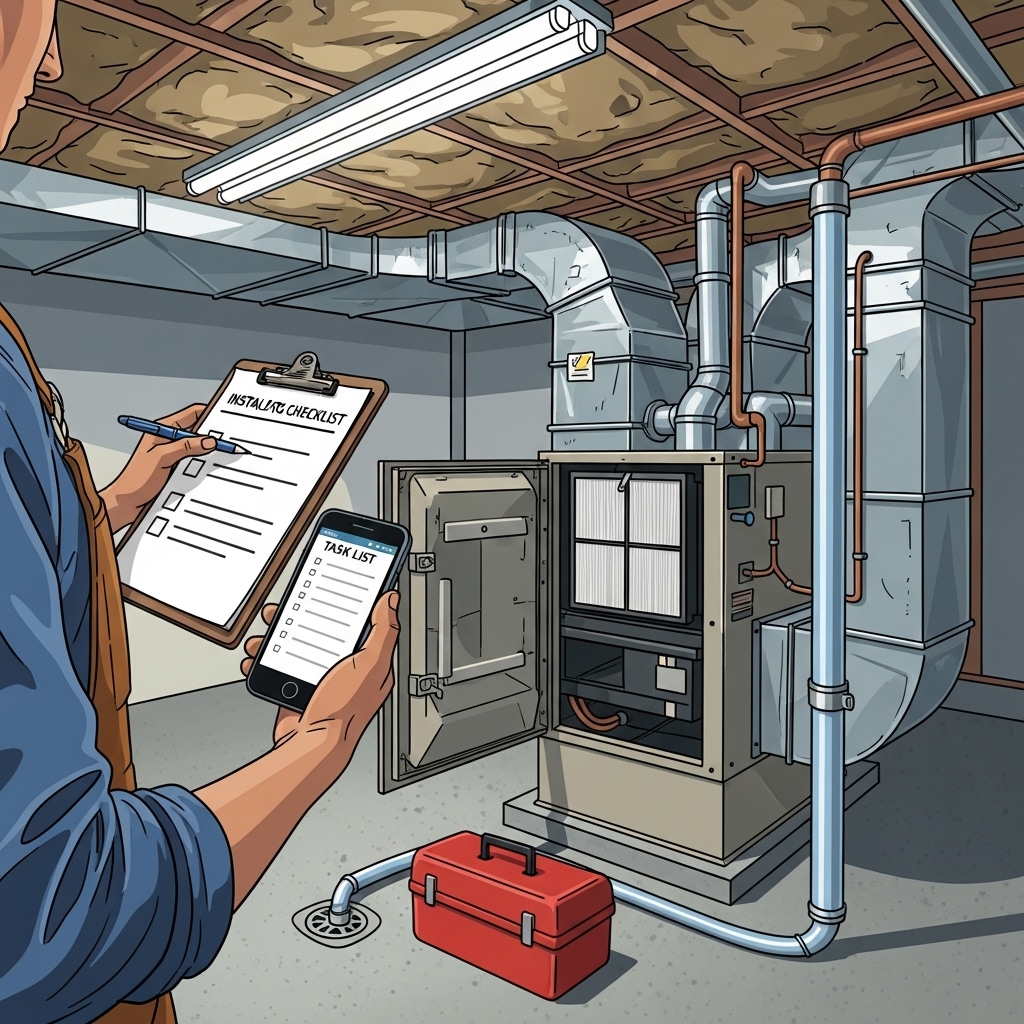
Introduction: Your Illinois AC Installation Checklist
A thorough checklist keeps your project organized and your home comfortable when summer arrives. Because Illinois homes range from historic two-flats to modern open-concept builds, details matter—duct sizing, equipment placement, and code compliance all influence how well your system performs. Use the following checklist to move confidently from the first call to the final inspection. As you review the steps, remember that effective air conditioning installation is a process with clear milestones, not just a single appointment.
This guide covers planning, permits, equipment selection, ductwork, electrical needs, commissioning, and maintenance. Keep it handy—print it or save it to your notes—and check off each item so nothing falls through the cracks.
Pre-Planning
- Clarify your goals. List comfort issues, rooms that run hot, humidity concerns, noise levels, and IAQ preferences.
- Gather home data. Square footage, insulation details, window orientation, and any recent envelope upgrades will inform sizing.
- Collect past records. Note the age and capacity of existing equipment and any recurring issues such as short cycling or uneven temperatures.
Permits and Code Requirements
- Call your local building department to confirm mechanical permit needs and inspection steps.
- Ask what documents are required: equipment spec sheets, site plan, and load calculation summary.
- Confirm electrical requirements for disconnects, breakers, and grounding in line with the National Electrical Code.
Load Calculation and System Design
- Request a Manual J (or equivalent) load calculation to right-size the system.
- Discuss duct design and airflow. Ask whether balancing dampers or added returns are recommended.
- Consider humidity control. Evaluate variable-speed or two-stage equipment for better moisture removal.
Equipment Selection
- Match indoor and outdoor components for compatibility and performance.
- Review sound ratings, warranty coverage terms, and filter options.
- Confirm thermostat compatibility with multi-stage or variable-speed systems.
Ductwork and Air Distribution
- Inspect for leaks, inadequate returns, or insulation gaps—fix before or during installation.
- Verify that supply registers and returns have proper clearances.
- Seal joints with mastic or approved foil tape and insulate ducts in unconditioned spaces.
Site Preparation
- Choose an outdoor location with proper clearances, good airflow, and away from dryer vents.
- Ensure a level pad or support that resists frost heave and provides service access.
- Clear pathways inside and protect floors to speed installation.
Electrical and Condensate
- Confirm dedicated circuit and correctly sized disconnect for the outdoor unit.
- Verify wire size, grounding, and breaker capacity with panel space available.
- Plan condensate routing with proper slope, traps as needed, and a safe termination point.
Installation Day
- Walk through the plan with the crew: equipment locations, line-set routing, and any duct modifications.
- Request neat line-set runs with UV-resistant insulation and protection from physical damage.
- Label filter sizes and locations for easy maintenance.
Commissioning and Verification
- Ask for documented measurements: superheat, subcooling, static pressure, and temperature split.
- Confirm blower speed settings and thermostat configuration.
- Review maintenance basics: filter schedule, coil cleaning, drain checks, and outdoor clearance.
Inspections and Closeout
- Schedule required inspections and keep copies of approvals.
- Store manuals, warranties, model and serial numbers, and calculation reports in a safe place.
- Set reminders for seasonal maintenance and filter changes.
Tips Specific to Illinois Homes
- Attics can be extremely hot and humid; ensure duct insulation is sufficient and consider air sealing to improve comfort.
- Basements and crawlspaces vary widely—verify dew point risk and install proper drains or pumps for condensate.
- In older homes, returns may be undersized; adding return pathways can dramatically improve comfort and noise levels.
Remember that the “middle” of your project is where coordination pays off most. Keep communication flowing with your contractor and inspector to avoid surprises. Treat air conditioning installation like a checklist-driven project with clear documentation and scheduled checkpoints.
Frequently Asked Questions
Q: Is a permit really necessary for a replacement? A: Many Illinois municipalities require one. It protects safety, ensures proper electrical work, and streamlines future real estate transactions.
Q: How often should filters be replaced after installation? A: Check monthly at first, then adjust based on dust levels, pets, and filter type—often every 1–3 months for standard filters.
Q: What if my second floor is hotter than the first? A: Ask about balancing dampers, additional returns, or zoning to address stratification and solar gain.
Q: Do I need a smart thermostat? A: Not necessarily, but smart controls can improve comfort and scheduling, especially with variable-speed systems.
Q: What documentation should I keep? A: Permits, inspection approvals, model/serial numbers, load calculation, manuals, warranty terms, and commissioning data.
Take the Next Step
With a clear checklist and organized documentation, you are ready to move from planning to installation day with confidence. When you are prepared to schedule professional work and a thorough commissioning process, book your air conditioning installation with a trusted Illinois team that understands local codes and climate.