Installing central cooling in an Illinois home requires careful planning, attention to code compliance, and methodical execution. Whether you are modernizing an older property or replacing an outdated unit, a well-organized plan will help you achieve comfort, efficiency, and longevity from day one. If you are exploring professional options or want to understand best practices before you begin, reviewing expert resources on air conditioning installation can provide a strong foundation. The overview below explains what to prepare, how to approach each major phase, and how to evaluate your results so your system performs reliably through humid summers and rapidly changing seasons.
Understand Illinois Climate and Home Needs
Illinois weather swings between hot, humid summers and chilly winters, which affects how you size, select, and configure your system. In summer, high dew points can push latent loads up, making humidity control as important as air temperature. When planning your system, consider the following climate-specific factors to keep your home comfortable and energy efficient:
- Humidity Management: Choose equipment and duct strategies that maintain indoor relative humidity in a healthy, comfortable range during peak summer months.
- Insulation and Air Sealing: Improve attic and wall insulation and seal air leaks to reduce cooling loads and prevent moisture infiltration.
- Zoning or Smart Controls: If you have multiple floors or large open areas, zoning can balance temperatures and reduce energy waste.
- Shoulder Seasons: Systems with variable speed blowers and staged compressors often perform better during mild spring and fall conditions.
Assess the Home and Define Your Scope
Before buying equipment, take stock of the current infrastructure and constraints. A thorough assessment ensures you select compatible equipment and avoid surprises during installation:
- Electrical Service and Panel Capacity: Confirm your panel can accommodate a new double-pole breaker for the condenser and dedicated circuits for air handler components.
- Duct Condition and Layout: Inspect ducts for damage, air leakage, incorrect sizing, and poor layout. Repair or redesign as needed for static pressure and airflow.
- Structural Clearances: Identify where the air handler, coil, and line set will run, and confirm you have proper clearances per manufacturer instructions and local code.
- Condensate Drainage: Plan reliable gravity drainage or a condensate pump with a safe discharge point and overflow protection.
- Outdoor Placement: Choose a condenser location with adequate clearance, level ground or a pad, and minimal sound impact to neighbors and living spaces.
Perform a Load Calculation
A Manual J (or equivalent) load calculation is the backbone of proper sizing. Avoid rules of thumb that can lead to oversizing, short cycling, poor humidity control, and higher utility bills. Load calculations account for envelope details, orientation, window performance, ventilation needs, and internal gains. With an accurate load, you can select equipment capacity that meets design conditions without sacrificing comfort or efficiency.
Select Equipment and Matching Components
Once you have your target capacity, choose equipment that complements your goals for comfort, efficiency, and budget, and that matches the realities of your duct system:
- Condenser and Coil Matching: Verify the condenser, evaporator coil, and air handler are AHRI-matched to deliver rated efficiency and performance.
- Compressor Type: Single-stage systems are cost-effective and reliable, while two-stage and variable-speed models offer improved humidity control and quieter operation.
- Blower and Airflow: A variable-speed ECM blower helps maintain steady airflow, supports better dehumidification, and adapts to filter loading and zoning.
- Refrigerant Type and Line Set: Use manufacturer-specified refrigerant and ensure line set diameter and length fall within guidelines for oil return and pressure drop.
- Thermostat and Controls: Choose a thermostat compatible with your equipment stages, dehumidification features, and any zoning components.
Verify Local Codes and Permits
In Illinois, most jurisdictions require permits for new or replacement air conditioning systems. Permits typically cover electrical work, mechanical installations, and sometimes refrigeration piping. Inspections validate safety, code compliance, and that equipment is installed to manufacturer specifications. Check your local building department for application steps, inspection stages, and any region-specific requirements such as pad height, set-back distances, or condensate discharge rules. Keep all documentation on hand for future home sales and warranty support.
Tools, Materials, and Safety
Assemble the right tools and focus on safety from the start. Mechanical and electrical tasks require care, and refrigerant handling should be performed by qualified individuals:
- Tools: Level, drill/driver, hole saws, tubing cutter, flaring or swaging tools (if needed), vacuum pump, micron gauge, manifold gauge set, digital thermometer, manometer, crimpers, and torque wrench.
- Materials: Line set, insulation, refrigerant (as specified), filter drier, whip and disconnect, pad, vibration isolators, mastic and UL-181 tape, hangers and support hardware, condensate components, and proper wire.
- Safety: Lockout/tagout for electrical, PPE (gloves, eye protection), ladder safety, and safe brazing practices with flame-resistant shields and fire extinguisher nearby.
Prepare the Site
Good preparation minimizes rework and ensures a clean, code-compliant installation. Start by laying a stable condenser pad on level, compacted ground or on frost-resistant base material. Verify clearances on all sides and above the unit to allow unobstructed airflow and maintenance access. Inside, position the air handler or furnace with coil for convenient filter replacement and service. Confirm return and supply ducts are sized appropriately and that transitions will avoid turbulence and high static pressure.
Set and Secure the Outdoor Unit
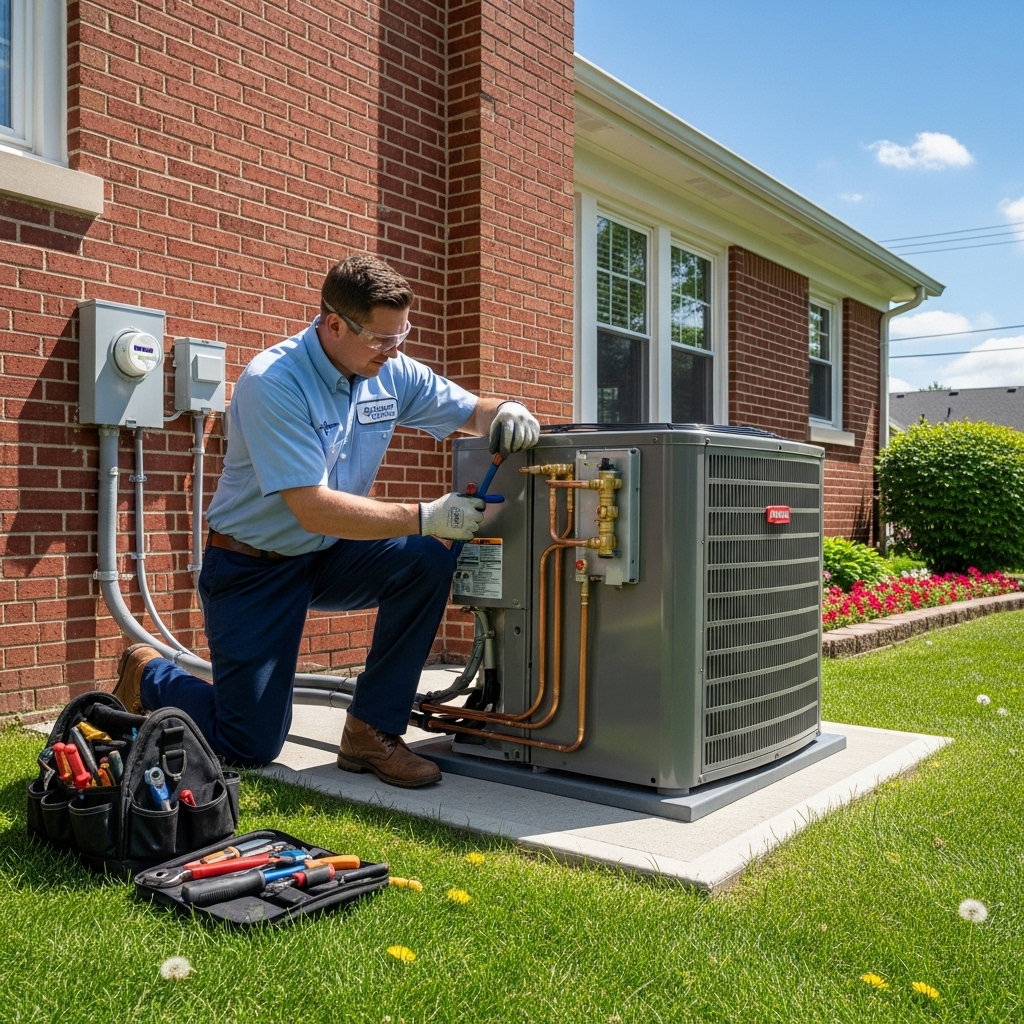
Place the condenser on the pad, verify it is perfectly level, and anchor it according to manufacturer instructions. Leave adequate service clearance for coil cleaning and electrical access. Route the line set pathway to minimize bends, protect from physical damage, and avoid long vertical risers where possible. Install a weather-resistant electrical disconnect within line of sight and a code-compliant whip from the disconnect to the condenser.
Install the Indoor Coil and Air Handler Connections
Mount the evaporator coil in the correct orientation for drainage, and seal all air pathways to prevent bypass and condensation issues. Ensure the coil casing is easily accessible for future service. Connect the suction and liquid lines with proper brazing techniques or manufacturer-approved fittings. If brazing, purge with nitrogen to prevent oxidation inside the tubing. Install a filter drier in the liquid line as close to the coil as allowed and in the appropriate direction of flow.
Ductwork Checks and Airflow Tuning
Air distribution is the heart of comfort. Confirm ducts are sized using Manual D principles and balanced with proper takeoff design, trunk sizing, and return pathways. Seal all joints with mastic or UL-181 tape and insulate ducts that pass through unconditioned spaces. Measure total external static pressure and adjust blower speed as needed to achieve manufacturer-required airflow across the coil. If static pressure is high, reduce restrictions by improving returns, resizing undersized runs, or upgrading to low-resistance filters with larger surface area.
Condensate Management
Set up a primary drain with proper slope and a secondary drain or float switch for overflow protection. Terminate the drain to an approved location that will not cause water damage or code violations. For installations where gravity drainage is not possible, use a rated condensate pump and follow manufacturer guidance for head height and check valves.
Electrical Connections and Controls
Run dedicated circuits from the panel to the disconnect and from the disconnect to the condenser using properly sized conductors and overcurrent protection. Inside, connect low-voltage control wiring with clear labeling. Verify thermostat compatibility with equipment stages, and configure dehumidification settings if offered by your system. Midway through your project planning, it helps to review professional guidance on air conditioning installation to double-check control strategies, wire sizing, and best practices for Illinois code compliance.
Evacuation, Charging, and Commissioning
Evacuate the system thoroughly using a vacuum pump and micron gauge to confirm a deep vacuum below manufacturer-recommended thresholds. Hold the vacuum to verify system tightness. Open service valves and weigh in the factory charge plus or minus any adjustments for line set length, as specified. With the system running, use superheat and subcooling measurements to fine-tune the charge. Record supply and return temperature differentials, static pressure, blower RPM, compressor amperage, and thermostat settings.
Noise, Vibration, and Finish Work
Install vibration pads or isolators as needed. Secure line sets with cushioned clamps to prevent rattles. Wrap and protect line set insulation from UV damage and wildlife. Weatherproof wall penetrations with appropriate sealants, and label disconnects and service panels. Inside, ensure filter access is unobstructed and that any service panels are reinstalled with tight seals.
Homeowner Orientation
Walk through system operation with household members. Explain thermostat controls, filter replacement intervals, drain safety devices, and what to do if the system trips a float switch. Provide documentation, warranty registration steps, and a record of measurements collected during commissioning. A brief orientation helps avoid nuisance calls and ensures the system is used as intended.
Maintenance Plan for Illinois Conditions
Seasonal maintenance keeps your system efficient and extends equipment life. In Illinois, schedule a spring tune-up to prepare for summer heat and a fall inspection to verify heating components if you have a combined furnace/coil setup. Key tasks include:
- Change or clean filters regularly to maintain airflow and protect coils.
- Wash the outdoor coil carefully from inside out to remove debris and cottonwood fluff.
- Inspect and clear condensate drains and test overflow switches.
- Check refrigerant pressures, superheat, and subcooling to catch performance drift early.
- Verify electrical connections, contactors, capacitors, and blower speeds.
Common Pitfalls to Avoid
Even experienced installers can run into issues that compromise comfort and reliability. Avoid these mistakes:
- Ignoring Load Calculations: Oversizing may cool quickly but will leave humidity high and waste energy.
- Neglecting Ducts: A new condenser cannot overcome undersized or leaky ductwork.
- Skipping Nitrogen Purge: Oxidation during brazing creates scale that can damage TXVs and compressors.
- Poor Drain Planning: Condensate leaks cause property damage and microbial growth.
- Inadequate Commissioning: Without proper measurements, hidden problems go undetected.
Illinois-Specific Notes
Municipalities across Illinois may vary in their adoption of mechanical, electrical, and energy codes. Some require proof of equipment matching, specific pad heights, or particular disconnect placements. Others may have strict rules regarding condensate discharge locations. When in doubt, call the building department, confirm local amendments, and schedule inspections at the prescribed milestones. Document everything for future reference.
FAQ
Q: Do I need a permit to replace my air conditioner in Illinois? A: In most jurisdictions, yes. Permits help ensure safety and code compliance, and they are often required for home sales and warranties.
Q: How do I know what size system I need? A: Use a Manual J load calculation. Avoid sizing by square footage alone to prevent oversizing and humidity issues.
Q: Can I reuse my existing line set? A: Sometimes. It must be the correct size, thoroughly cleaned or flushed if allowed, and meet manufacturer requirements. Many installers prefer replacing the line set whenever feasible.
Q: What is the ideal indoor humidity in summer? A: Generally 45–55% relative humidity is comfortable and healthy; your system’s setup and run times influence this greatly.
Q: How often should I change filters? A: Check monthly during heavy use and change as needed. High-MERV filters with greater surface area can maintain airflow longer.
Next Steps
You now have the framework to plan and execute a safe, efficient installation tailored to Illinois homes. If you decide that professional support, code guidance, or a turnkey installation would better suit your timeline and comfort goals, reach out to a trusted local team. To learn more or to get started, explore expert resources and schedule a consultation for air conditioning installation today.