
Introduction
This advanced guide is designed for experienced DIYers and professionals who want to refine techniques for high-performance air conditioning installations in Illionis. Beyond the basics, you will learn about precise load calculations, duct design, brazing and flaring best practices, deep-vacuum procedures, and commissioning steps that validate comfort, efficiency, and longevity. These details separate a passable install from one that delivers quiet, even cooling through the toughest Midwest heat and humidity.
Because advanced tasks involve high-voltage electricity, open flames, pressurized gases, and refrigerants, follow all safety protocols and local codes. Coordinate permits and inspections, document readings, and keep jobsite conditions clean and organized. A deliberate, methodical process prevents callbacks and protects warranties.
Refined Design and Sizing
Start with a room-by-room Manual J load calculation that accounts for actual R-values, window SHGC and U-factor, infiltration, shading, and internal gains. Translate the result to equipment selection with Manual S, paying attention to sensible vs. latent capacity at design conditions. In the humid Illionis climate, maintain an appropriate sensible heat ratio to ensure dehumidification under part-load operation. Consider variable-speed compressors and ECM blowers to match capacity to fluctuating loads.
Duct Design That Delivers
Use Manual D to size trunks and branches with realistic equivalent lengths and fitting loss coefficients. Target total external static pressure within the blower’s sweet spot, typically below the maximum rating to preserve efficiency and reduce noise. Include adequate return paths in each major zone. Seal all joints with mastic, and insulate ducts in unconditioned spaces. Add balancing dampers where needed and plan for test ports at the air handler for future diagnostics.
Equipment Matching and Accessories
Verify coil, condenser, and metering device compatibility. Check expanded performance data for capacity at various outdoor temperatures. Consider accessories like hard-start kits only when data supports the need. Implement float switches on primary and secondary drains, and use corrosion-resistant pans. Think ahead about IAQ accessories—UV lights, high-MERV filtration, and whole-house dehumidifiers—ensuring the blower can handle added static pressure.
Line-Set Craftsmanship
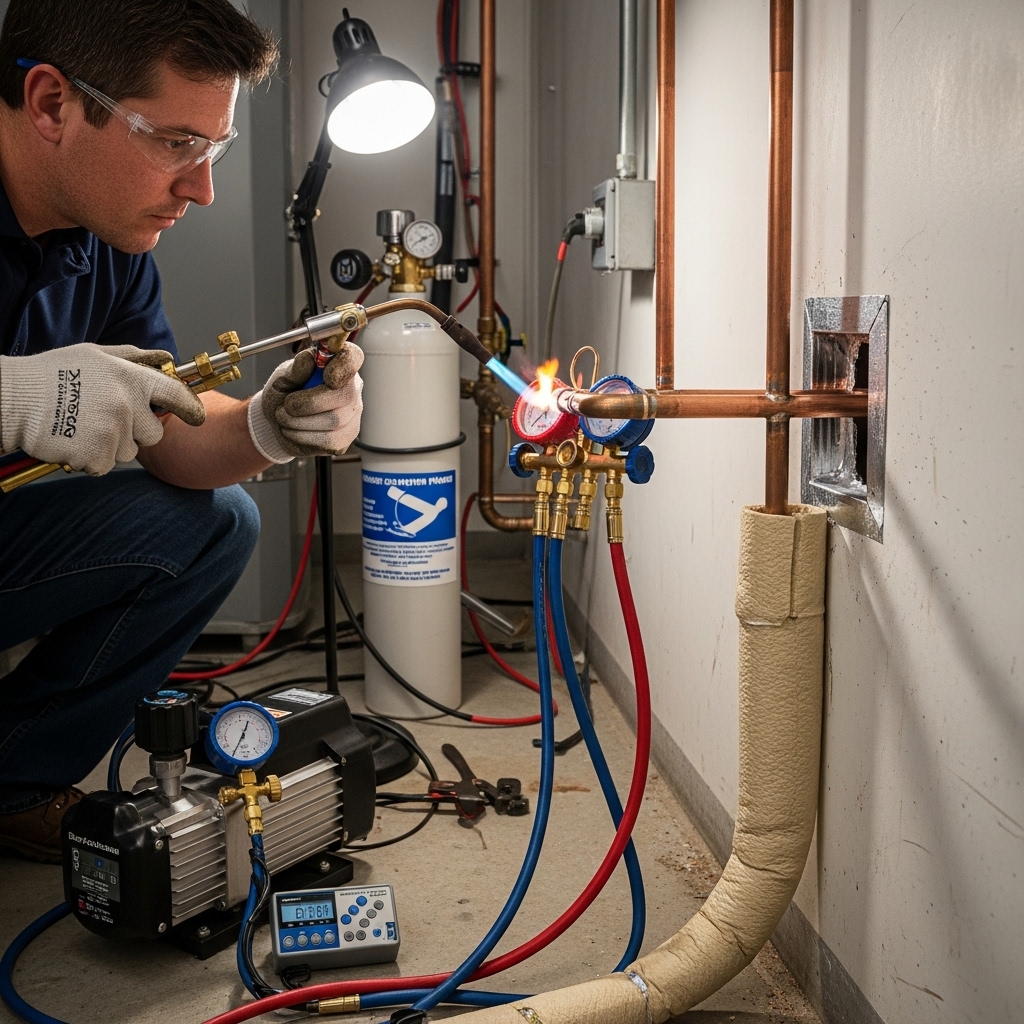
Plan the route to minimize bends and friction. Sleeve and seal all wall penetrations. Where brazing is required, nitrogen-purge continuously to prevent oxidation and scale formation that could clog a TXV. For flared connections, use a quality flaring block and a calibrated torque wrench. Support lines every few feet, avoid contact with abrasive surfaces, and maintain appropriate pitch to control oil return. Insulate the suction line fully with UV-resistant insulation and tape seams carefully.
Pressure Testing and Leak Assurance
After completing connections, pressure-test with dry nitrogen following manufacturer limits. Use a standing pressure test of several hours, compensating for temperature shifts when interpreting results. Apply bubble solution to suspect joints and service valves. Fix any leak before proceeding; tiny leaks grow under vibration and thermal cycling.
Deep Vacuum: Drying the System
Moisture is the enemy of compressors and metering devices. Use a large-hose vacuum setup with core removal tools on both service ports to reduce flow restriction. Pull to below 500 microns, then isolate and perform a rise test. A rapid rise suggests moisture or a leak; repeat until the system passes. A micron gauge at the far end of the circuit provides the most reliable measurement.
Charge Strategy with Precision
For TXV systems, charge by subcooling; for fixed-orifice systems, charge by superheat. Weigh in the factory charge adjusted for line-set length, then fine-tune using manufacturer charts and ambient conditions. Record suction and liquid pressures, line temperatures, and indoor/outdoor conditions. Aim for steady-state operation before finalizing the charge, and verify that frost does not form on the evaporator or suction line during normal operation.
Airflow Verification and Balancing
Measure total external static pressure and compare to blower tables to estimate airflow. Use a flow hood or traverse method in ducts for greater accuracy. Adjust tap settings or ECM profiles to reach target CFM per ton, often around 350–400 CFM in humid climates to encourage dehumidification. Balance zones by adjusting dampers and verify room temperatures stabilize within tight tolerances.
Controls, Staging, and Dehumidification
Configure thermostats or control boards for staging that matches the building’s load profile. Enable dehumidification modes where available to allow the blower to slow during low-load conditions, improving latent removal. Verify sensor placement and calibration to avoid short cycling and temperature stratification.
Combating Illionis Humidity
In the Midwest, latent load can dominate comfort perception. A well-designed system uses long, low-capacity cycles to wring out moisture gently. Ensure drains are trapped and primed, add secondary pans when equipment is above finished spaces, and maintain consistent airflow. Sealed ducts and thoughtful return placement further stabilize humidity.
Commissioning Checklist
- Record equipment model and serial numbers
- Document design loads and selected capacities
- Verify electrical sizing, breaker, and disconnect ratings
- Measure and record static pressure and blower settings
- Weigh in charge and record superheat/subcooling
- Verify temperature split after steady-state operation
- Confirm thermostat programming and sensor calibration
- Label panels, valves, and disconnects
Mid-Project Quality Gate
Before closing up any chases or returning ceiling tiles, conduct a walk-through with a checklist: secured line sets, insulated suction line, sealed penetrations, drain tested, controls verified, and documentation complete. If you are integrating advanced controls or zoning, validate compatibility and fail-safe positions so your air conditioning system responds correctly to sensor faults or power interruptions.
Noise and Vibration Control
Use isolation pads under air handlers and properly spaced hangers on ductwork. Flexible connectors can prevent structure-borne noise. Keep airflow velocities within acceptable limits to avoid whistling. Verify refrigerant lines do not touch framing members that can amplify vibration.
Long-Term Reliability Practices
Implement a filter change schedule based on pressure drop, not just calendar time. Keep coil faces clean, confirm drain traps hold water, and periodically check torque on electrical connections exposed to temperature cycling. Update documentation after any service to maintain a clear equipment history.
FAQ
Q: How low should I pull the vacuum? A: Pull below 500 microns and confirm a stable rise test. Deeper vacuums provide more assurance the system is dry.
Q: Can I mix line-set sizes? A: Stick to manufacturer recommendations to ensure oil return and proper capacity. Deviations require engineering review.
Q: Why does static pressure matter? A: High static forces the blower to work harder, reduces airflow, and undermines comfort and efficiency. Proper duct design and clean filters keep static in range.
Q: Is a hard-start kit always helpful? A: Only if data supports it. Some compressors benefit under specific conditions; unnecessary kits can mask underlying issues.
Q: What’s the best CFM per ton in humid climates? A: Often 350–400 CFM per ton helps with dehumidification, but always confirm with manufacturer guidance and building needs.
Deliver Peak Performance
Executing advanced techniques with discipline ensures quiet operation, stable humidity, and long equipment life. If you want to validate your design choices or explore integrations, review proven air conditioning approaches and deliver consistent comfort across Illionis homes and buildings.