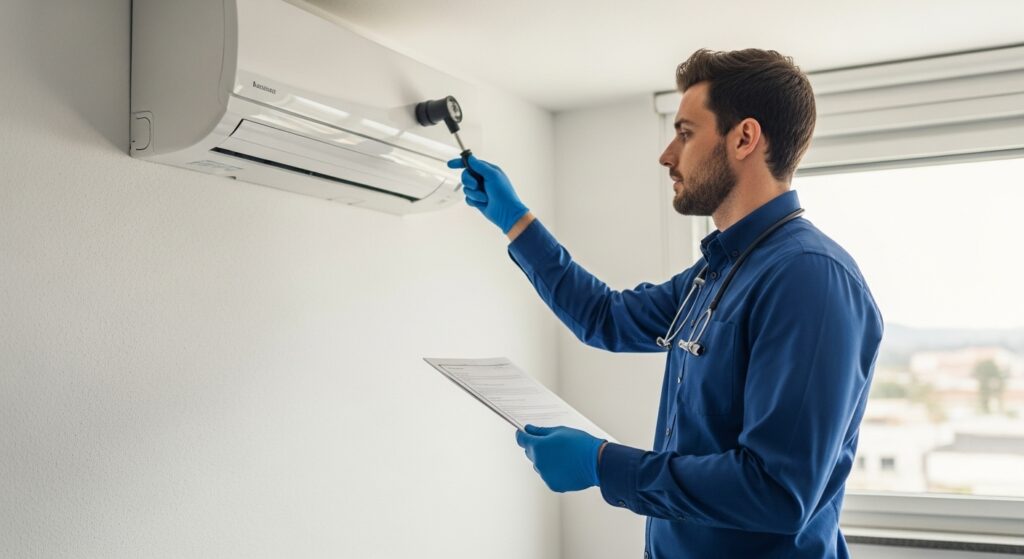
In Skokie’s retail corridors, medical offices, and mixed-use buildings, air conditioning is a mission-critical system. Tenant comfort, equipment protection, and indoor air quality all depend on proactive, well-documented maintenance. Unplanned downtime risks lost revenue, product spoilage, and negative customer experiences; planned upkeep, on the other hand, stabilizes operating costs and preserves asset value. This guide explains commercial air conditioning maintenance through the lens of Skokie’s climate and building stock, providing a clear framework for property managers, facility directors, and business owners to implement reliable routines. By structuring your program around scheduled inspections, data-driven performance checks, and seasonal tasks, you’ll turn air conditioning maintenance into a competitive advantage.
Commercial systems vary widely: packaged rooftop units (RTUs), split systems serving suites, variable refrigerant flow (VRF), and chilled-water plants with air handlers. Regardless of type, the themes are the same—airflow, cleanliness, electrical integrity, safe condensate management, and controls tuned to occupancy. The sections below outline a maintenance strategy that scales from a single-tenant retail space to a multi-story office complex.
Program Foundations: Safety, Scope, and Documentation
Commercial environments demand clear procedures and recordkeeping. Start with a written scope that defines tasks, frequencies, and responsibilities for in-house staff and vendors.
- Safety: Lockout/tagout procedures, rooftop fall protection, and ladder protocols are non-negotiable. Equip staff with PPE and training.
- Asset inventory: Catalog each unit by model, serial, location, tonnage, refrigerant type, filter size, belt size, and motor details.
- Maintenance calendar: Map quarterly and seasonal tasks, aligning with Skokie’s spring pollen and summer humidity peaks.
- Documentation: Use standardized checklists and log data points—amps, volts, delta-T, static pressure, and discharge/suction temperatures.
Quarterly Maintenance for Packaged Rooftop Units
RTUs dominate many commercial roofs for their simplicity and accessibility. A robust quarterly routine keeps them efficient and predictable.
- Filters: Replace with commercial-grade media matched to fan capacity. Verify pressure drop stays within design limits.
- Coils: Inspect condenser and evaporator coils. Clean with manufacturer-approved methods to preserve fin integrity.
- Belts and pulleys: Check tension and alignment; replace worn belts and lubricate bearings as specified.
- Electrical: Inspect contactors, capacitors, relays, and wiring. Tighten lugs and test microprocessor boards for fault codes.
- Condensate: Clear drains and traps; confirm proper trap height for negative pressure air handlers.
- Economizers: Inspect dampers, linkages, and sensors. Calibrate minimum outside air setpoints and verify free movement.
- Controls: Test thermostat or BAS points, verify staging, and ensure setbacks align with occupancy.
VRF and Split Systems: Additional Considerations
VRF systems bring zoning flexibility but require meticulous commissioning and maintenance. Split systems in tenant suites benefit from many of the same practices as residential units, modified for higher duty cycles.
- Refrigerant management: Follow manufacturer procedures for leak testing and charge verification. Protect data integrity with detailed logs.
- Indoor units: Clean filters and condensate pans, verify fan speeds per zone design, and ensure quiet operation in professional environments.
- Communication networks: Inspect cabling and terminations for VRF systems; faulty networks can mimic refrigerant or airflow problems.
- Sensors and setpoints: Validate temperature and humidity sensors. Calibrate where possible and document any offsets applied in the BAS.
Seasonal Tasks for Skokie’s Climate
Aligning maintenance with local conditions prevents mid-season disruptions and keeps tenants comfortable through heat waves and sudden storms.
- Spring: Deep-clean coils, confirm economizer operation, replace filters, flush condensate lines, and verify that hail guards and bird screens are intact.
- Summer: Monitor delta-T, suction/discharge pressures, and compressor amps weekly during peak heat. Clear debris after storms and ensure condensate systems handle heavy humidity.
- Fall: Clean coils again to remove summer dust, check hail damage, and prepare RTUs for potential freeze-thaw cycles affecting roof penetrations.
- Winter: Protect idle condensers with breathable covers where appropriate, and perform IAQ projects like duct sealing and insulation upgrades.
Controls Strategy: Comfort, IAQ, and Energy
Controls are where maintenance meets outcomes. Well-tuned scheduling and ventilation strategies yield quiet comfort and cleaner air with fewer complaints.
- Scheduling: Align setpoints with hours of operation and pre-cool gradually before peak occupancy.
- Ventilation: Set minimum outside air based on code and occupancy, and use economizers when conditions allow free cooling.
- Humidity: Target mid-40s to mid-50s percent relative humidity for comfort and productivity. Consider reheat strategies or dedicated dehumidification if necessary.
- Alarms: Configure the BAS to alert on trends—rising fan amps, falling delta-T, or frequent short cycling.
Performance Metrics and Benchmarking
Data transforms maintenance into management. Attach a small set of metrics to each unit and watch for drift over time.
- Delta-T (supply-return): Track against design; significant changes indicate fouling or charge issues.
- Static pressure: Rising static suggests filter loading or duct restrictions.
- Compressor and fan amps: Trending high amps warn of mechanical wear or coil fouling.
- Energy intensity: Compare kWh per square foot year-over-year to evaluate improvements.
Risk Management and Redundancy
Critical spaces—server rooms, medical suites, and refrigeration-adjacent areas—need contingency planning. Identify priority units and build redundancy where feasible.
- Spare parts: Stock common belts, filters, contactors, and capacitors.
- Rapid response: Establish vendor SLAs and escalation pathways for heat wave emergencies.
- Load shedding: Define non-critical zones you can relax temporarily to protect critical cooling.
Roof and Site Considerations
Skokie’s storms and winter freeze-thaw cycles are hard on roofs and penetrations. Good roof hygiene supports HVAC reliability.
- Keep service paths clear and slip-resistant.
- Inspect curbs, flashing, and pitch pans for water intrusion that could reach electrical components.
- Secure hail guards and bird screens to protect coils without restricting airflow.
Communication With Tenants and Staff
Human factors drive comfort perception. Clear communication reduces complaints and speeds resolution when issues arise.
- Provide a simple guide for thermostat use and how to report problems, including preferred temperature ranges.
- Encourage sensible behaviors—keeping doors closed, minimizing heat-generating equipment near thermostats, and reporting water near units promptly.
- After service visits, share summaries of findings, repairs, and any recommended follow-ups.
Choosing and Managing Vendors
Strong vendor partnerships produce consistent results. Evaluate providers on responsiveness, technical proficiency, documentation quality, and references from similar facilities.
- Require detailed maintenance checklists and data logs after each visit.
- Ask for before-and-after photos of coil cleaning and electrical repairs.
- Set expectations for parts stocking and lead times during peak season.
- Seek proposals that pair routine service with performance improvements, such as economizer retrofits or advanced filtration.
Frequently Asked Questions
Q: How often should commercial AC filters be replaced? A: Quarterly is common, but high-dust or medical environments may require monthly changes. Base the interval on measured pressure drop.
Q: What’s the most important RTU maintenance task? A: Coil cleanliness. Clean coils stabilize delta-T and reduce compressor load, preventing cascading failures.
Q: How can we verify our vendor’s work? A: Require logged measurements—amps, volts, static pressure, delta-T—and compare to prior visits.
Q: Do economizers really save energy in Skokie? A: Yes, during mild spring and fall days. Maintenance must keep dampers and sensors calibrated to realize savings without humidity issues.
Q: When should we schedule professional maintenance? A: Early spring for pre-cooling prep and mid-summer check-ins during heat waves for critical sites.
Keep Comfort a Business Advantage
A disciplined maintenance program reduces complaints, protects equipment, and lowers risk during peak demand. With clear schedules, documented performance, and responsive vendor support, you keep tenants comfortable and operations smooth through Skokie’s toughest days. For diagnostics, coil cleaning, and tune-ups that align equipment to design specs, schedule professional air conditioning maintenance and keep your building reliably cool.